Wednesday, April 29, 2009

There and Back Again

I have returned unscathed. Relatively unscathed. There may have been a slight bit of scathing, around the edges. If it doesn't clear up in a day or two I might go see a doctor, but for now I have an ointment for it.

Montreal was beautiful, of course. I would go into exhaustive detail, were this not a blog about video games but instead, say, on being young and in love in the springtime. What is it about the blogosphere, I wonder, that lends itself to a propagation of the former and a distinct lack of the latter? We may have to remedy this trend at some point, to ensure our survival as a species.

I was lucky enough to be paired on a panel with Bernard Perron, the mad scientist of horror games himself and the organizer of the whole shindig. I have nabbed this photo from the website, listed under the heading of "Aftermath," a word that I think sums things up perfectly.


Here I can be seen struggling to answer the age-old question that has vexed mankind for millenia:

Videogames... are they videogames?


- Rook

Monday, April 20, 2009

Loira, Morena, Ruiva


When I wrote earlier about blogging as I produced my presentation for Thinking After Dark, I had assumed it would be a gradual affair, moving through chapters in a modular essay as I've done twice previous. And it's not from lack of material that I haven't - quite the opposite, as I find myself sitting atop a heap of writing that may not be so much the basis for a 30-minute spiel as the start of a book. Let it be said that I am never accused of bringing a knife to a gunfight.


Rather, the things I've find myself drawn to write about over this last month have been all peripheral, concerning the process of writing this as opposed to the actual article. This may stem from my structuralist baggage, which leaves me with a chronic craving for metanarrative... though I prefer to think of this as a side-quest.


Always when I sit down to round up my data, I am amazed by the intricate play of facts against one another, forming patterns of data that were imperceptible until plotted. As the opposite of quantum events that collapse upon observation, these are configurations that seem to leap from the page, called into being by their very arrangement. I suspect this is a sensation that is felt in earnest by mathematicians, programmers and Spirograph-enthusiasts... where the layman sees a scrawl, the crunch-head sees patterns: blonde, brunette, redhead.


It's in this fashion that when I sit down to write, I instead catch myself writing on writing. Of course, in this case I am writing on writing on writing. You can see how quickly this becomes ridiculous. Despite everything, though I can't fault the process - it's always an unintended thrill when you set out to produce one thing, and get something entirely other instead. Ta da! Magic!


Here's to the little alchemies of our age.


- Rook

Thursday, April 16, 2009

Things That Go BLEEP-BLOOP in the Night


Your humble co-narrator has been busy. Busy with video games.

It might be suspected that as far as business goes, video games might be one of the more pleasant things to be busied with. And, heck, I would have thought so too! But in playing some two dozen horror video games in rapid succession, jumping across systems and decades in a craven search for an understanding of the breadth of the matter, I fear I have begun to do immeasurable damage to my psyche.

In true Lovecraftian form, I may have unearthed secrets not fit for the gaze of man. Each of these games, after all, serves as an attack on a player’s sensibilities. To be truly afraid, something must be undone, leaving some fuse in the viewer’s lizard brain frayed and sparking. But each of these games chooses a different approach, a separate jab and feint that may be radically different from others of its kind. Put together they form a kind of onslaught upon all regions of the self, like a particularly virulent form of Neitzschean nihilism but with way way more zombies.

Like the Inuit's apocryphal hundred words for snow, I am discovering new words for FEAR.


FUN FACT: In one ten second period, Christopher Guest says "suck" four times.


These varying visions of spookiness jumble together, a melange in the slow cooker of my subconscious. These horrors take hold of me when I least expect them... I have begun to be plagued by fevered dreams! In some, I am assisted by my erstwhile companions, but often I am alone. Perhaps I am on a spaceship, or in a strange town, or confined to a mall or a haunted house. Sometimes I have a gun, or something else entirely, but often I have nothing.


In every dream I am chased by something... something inscrutiably terrible, seen only in the corners of my eyes. It looms over me, hovering, long, black finger of a forgotten god.


Is it.. Oh, God, is it? It is! IT IS!

It's an Atari 2600 Joystick!


I didn't even know they still made those.


- Rook

Friday, April 10, 2009

Braid for Windows!


This is imperative! Braid is now available on Windows and can be downloaded online through Greenhouse and Steam for 15 dollars of the American persuasion. Buy it, buy it now!


Seriously, this game is important.

-King

Tuesday, April 7, 2009

I've got Tomes in Different Area Codes


It is with satisfaction that I announce that the trip to Toronto was a complete success. King was kind enough to meet me, and help me navigate the winding, labyrinthine streets of the city.


Not pictured: Anything remotely winding, labyrinthine.


King's presence was absolutely crucial, as I find my standard mode of navigation is useless in the ci-tay. You see, I travel by intuition, like a dowser or Inigo Montoya. When I want to get somewhere, I begin walking in the direction that feels right. At some point, either I arrive there, or it stops feeling right, at which point I change tack and try again. As a method it is extremly innacurate but unfailingly precise... I find that if I keep on trucking, I get there eventually.

But of course, like all extremely inaccurate pursuits it functions properly only on small scale. In any vista roughly bigger than, say, Lake Wobegon, my sensors get all jimmied. Without a friendly guide, a Virgil to my Dante, I would be like a moth besotten by an incandescent light, wheeling in endless circles and crashing into things with my face. I'd be trapped in the city forever, and after years of hardship might end up like Zanta. Yes yes yes!


This colourful character has a Wikipedia page, and you do not. How's that for notability?


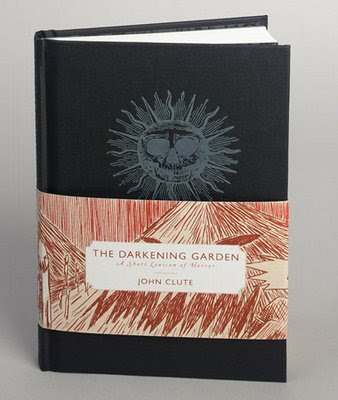
But, of course, such was not our fate. We were able to visit a series of libraries, delving into foreboding tomes and drinking deep from the eldrich secrets contained within. Of especial interest to me was one particular book, which pretty much sets the bar for foreboding tomes. I'm serious, this tome will forbad you right the frick out.


Guys, I think that zombie sunflower just winked at me.

So now I've got my books, and am home in one piece. It's time to start writing a thing about scary things. To those following, I'll be blogging on the bits of my essay that will coalesce over the next two weeks, a technique that I have come to lovingly term 'double-dipping.' BONUS FACT: When you Wikipedia Double Dip (sweet), you encounter this humdinger of a sentence:

"The Swizzel Stick that you can gather the sherbet has been described as one of the "best" sherbet sticks around by many critics of confectionery."

BAM. Take that, other swizzel sticks. The many critics of confectionary have spoken.

- Rook

Thursday, April 2, 2009

On Plinko and Pizza


I study games and play theory, but I am a terrible theorist. I have met many who are genuinely interested in theory for it's own sake: those who theorize up great and terrible edifices, each clarion thought bricked and mortared up to palatial heights, who rule from these structures like the shahs of old. I am not of their number, for the single damning reason that I do not love thoughts. I love things.

Because of this, of course, I am all turned around. I twist the rule a little. I cheat. Instead of being content to focus on my little puddle of academia, I turn outward, and see a world constantly at play. Every moment I see odds and probabilities at work, rules exchanged, wagers made, and scores silently tallied. This may be a defense mechanism against the vacuity of chaos: Living in a universe that is constantly, infinitely flipping coins, you may as well ante up.

Through simple legerdemain, my humble little body of thought becomes a lens to see the world. Similar the sociological assertion that "The personal is political," Robert King's insight that "the truth about stories is that's all we are," or Richard Carlson's brainless advice "Don't sweat the small stuff... and it's all small stuff," there is that gentle plying until you feel someting give, and suddenly you are talking about everything.

So I study games and play, and it is all games and play. (Until someone loses an eye.) As a mutually-inclusive proposition, it is the opposite of a Catch-22. I call it my Catch-21.

I've written before on my propensity to to turn the most mundane tasks into games. What I may not have mentioned is that I do this constantly, every day. These games scale in significance with the task at hand. Last weekend I headed to my hometown, for a marathon of three years worth of taxes. It seems that the MAN had finally tracked me down, and insisted that, apparently, not doing your taxes is simply not an option. The alternative, as I understand it, is debtor's prison. And I figured, if it could happen to John Dickens, holy smoke, it could happen to me.


Canada I am sorry, please don't put me in the gaol.


But in settling in for a weekend's worth of number crunching, I was pleasantly surprised to remember that I actually find taxes to be super funtimes. You take one number, and start at the top, and it falls down and changes and you add and subtract, and it clicks right along. Now something's happening, but I'm sure I have no idea what. To me, it's like sidling up to an enormous pachinko machine, like Plinko on The Price is Right. And let it be said that I am a man who enjoys his Plinko.

And after everything as been totaled, the numbers go click click click down the page until they land in one or two boxes. In the right box, you lose money. In the right box, you win money. Jackpot!

FACT: Asking someone if boot camp was "a lot of fun" is super classy.

It struck me then that I subscribe to what I might call Plinko Theory. Faced with odds over which I have no control or no ken, I tend to just go limp and let things play out. For example, this is my exact behavior when travelling: I map out every variable ahead of time, so when the time comes I can simply be processed, click click click from destination A to B to C. I've often wondered what would happen if I missed a turn-off, or got on the wrong bus, or simply got spun around and started walking in the wrong direction. What if you dont catch yourself in time? Then instead of landing in the right box, you wind up in Timbuktu.

Are our lives like this, too? If we were to start again, and go click click click through everything, perhaps we'd wind up in different boxes, as completely different people. Is it really just Plinko Boards All The Way Down?

It was in this zen-state I found myself on the the trip back, having been deposited at a Go-bus station in Newmarket, waiting for another bus to schlep me to Toronto, then home. All of us stood quietly, gently swaying, waiting for our bus. Liminal theory posits that such places are instances of non-space, and that in these places we are like ghosts, neither alive or dead. I find my experience to be the opposite - in these places I have a hypersensitive awareness of my body, brought on by the fatigue of travel. Everything hurts. I can feel my bones ache, and my skin. I fish my tongue around in my mouth and suck my teeth. I taste blood, and noticed the tip of my tongue was bleeding.

Suddenly, and with a terrible ferocity, I realized I was HUNGRY. I stumbled into the station and made my way to a small convenience counter, where I spied a few lazily rotating pizzas, looking withered and uninviting. I tried to speak to older Indian gentleman who was siting behind them, but he held up his hand in front of him, blocking my very words as they came tumbling out of his mouth. His daughter then, scurried over to take my order.

Zombielike from travel, I wasn't entirely aware of myself. The moment my purchased pizza was delivered into my waiting hands, I began stuffing it into my face in large wolfish bites. I may have been making OM NOM NOM noises as well. I looked up, and noticed that I was chowing down right in front of the young woman who had served me. She was smiling.

All the synapses in my brain started firing off at random. I realized I had about half a second to communicate something - anything - that would explain myself. I couldn't smile back, as my face was crammed with food. My hands were full, and my skull was empty. But I had to do something.

So I winked.


- Rook

Wednesday, April 1, 2009

I was wrong and I'm sorry

So in light of new evidence it looks like I have to take back all that smack I talked about Super Smash.

It turns out that it was just a big misunderstanding. All the characters are really good friends, as demonstrated by their dancing together on the internet to sped-up Swedish europop.


Who knew? Gosh, not me.

- Rook

Monday, March 30, 2009

More than Pac-Man with a Bow: Super Smashing GENDER CONSTRUCTS


Now, I will be the first to admit that constructs are hard to take on. Between their immunity to critical hits and invulnerability to effects that require a fortitude save, they are tough hombres to smash. But I must prevail! How else can we hope to resurrect that one Wayans Brother?


Snails, don't! NOOOOOOOOOOOOOOOOOOOOOOO.

All right. Got that out of my system. Now... where were we again? Right.

In each case, these characters have inherited signs from a more limited period of gaming technology, these vestiges are not so easily swept aside. Now codified into icon, they are projected through generations of gaming systems and gamers alike, becoming more elaborate through history and momentum.

These exaggerations of sign, from Peach's hyper-victimhood, Samus' dual role as able warrior and sexy space hooker, and Zelda/Sheik's gender and form ambiguity are all on full display in a game such as Super Smash Brother's Brawl, which combines gaming characters from a vast array of franchises to duke it out.

The results are as-expected. Peach still swings about frying pans and dishes out slaps. She cowers behind her retainer, floats about on a parasol, ever-reaching towards new heights of inspired uselessness. Samus is the same heavily-armored space mercenary, at least until she delivers her final smash and her suit literally falls off her body. And Zelda/Sheik are dual roles of the same characters, toggling between a slow, heavily defensive sprite to an agile finesse-fighter at the flip of a button. As a further point of gender-bending, here Sheik is referred to exclusively as a woman, and whose reconceptialized art is more feminine, while still retaining most of the masculine characteristics.


Sisters are super smashing it for themselves.

Though not every game can highlight the disparate signs of a handful of franchises as well as Super Smash, elsewhere the brawl rages on - where once game designers had to struggle to convey even the most basic information through their characters, today's characters must fight to be rid of the parasitic signs of earlier ages.

We've seen nearly three decades of damsels-in-distress and sexpot adventurers, figures either exemplified by their static weakness or their zealous enthusiasm to be fetishized while in the line of duty. These preconceived notions of what femaleness is, and does, don't only interfere with the creation of fully-formed characters. In defining playable, capable gaming experiences as implicitly male, and passive, captive and inert experiences as female, they perpetuate a false dichotomy within which gender discourse is bound to be skewed, misunderstood, or relegated to the sidelines.

Film historian Jan Oxenberg spoke of the experience of being "starved for images of ourselves on the screen". Despite modest successes, the stale tropes of an earlier age continue to deplete the cultural stock that video games, as a medium, draw from. In order to flourish, we will need new images: New generations of female characters drawing from new negotiations of sex and gender., communicated through new signs.

Only then will autonomous female characters become the norm. Otherwise, they are doomed to remain shadow imitators, relegated to the background: Just Pac-Man with a bow.


(Did you see what I did there I totally just used my title again.)


- Rook


Tuesday, March 24, 2009

More than Pac-Man With a Bow: Part 4


"It's like the Adventures of Link. He has to find Zelda, you have to find a house... "
"Boy, is that sexist."
"It's not sexist! It's... romantic."

- The Wizard, 1987


I've been invited by the Escapist to discuss the role of The Legend of Zelda's Sheik in an upcoming issue on gender. I'll link there from here when it goes live.

May I say, with the risk of spoiling the surprise, that dude looks like a lay-day.


- Rook

Tuesday, March 17, 2009

More than Pac-Man with a Bow: Part 3


"He touched my breast!"

"I touched her breast? She doesn't have breasts! "

- The Wizard, 1987


Originally, nothing much was known about Samus Aran, the protagonist of Gunpei Yokoi's Metroid. The instruction booklet only states that Samus is a bounty hunter, shrouded in mystery. At the end of the game, having blasted through a horde of hostile aliens, that mysterious shroud is pulled away, with Samus' armor flickering and disappearing, revealing a long-haired woman.

Metroid's twist ending, which outed the calm and collected space marine as female, has long been touted as the emergence of the first empowered female character in gaming. But what is often ignored is the context in which Samus emerges: One of glorified, 8-bit peepshow.


With Metroid being a non-linear game, the time it took to complete could vary greatly as players became more accustomed to the layout. Depending on the time taken, the 'reveal' of the ending changed slightly. Take longer than five hours, and Samus merely raises her first in triumph. Take between three and five, and Samus' helmet disappears, revealing her long hair. Less than three hours nets you a shot of Samus in a leotard... and less than one hour rewards you with a shot of Samus in a bikini.


In space, no one can see your tan.


Samus, then, manages to be both hero and damsel, half space pirate and half space booty. In her bulky armor, devoid of female signs, Samus is functionally male - the instruction book even goes so far as to refer to her as a man. It is only when the game is finished, the threat is overcome, and control is passed over to the credits that Samus may safely emerge as female. This movement from Samus-player to Samus-object is explicitly one of orientation: As controlled during the game, the Samus is inhabited. During the credits, stripped to her skivvies, Samus is merely regarded.


The idea of Samus naked under her macho spacesuit is one that has remained with the Metroid series through its many incarnations, to the point in which it moved beyond tongue-in-cheek end gag to gameplay feature. In Metroid: Zero Mission, Samus is ambushed by space pirates and makes a crash landing... which, of course, damages her suit. Here we are re-introduced to Samus in her undergarments, a form-fitting bit of blue spandex aptly titled a "Zero Suit".. though perhaps "birthday suit" would be more appropriate given the circumstances.


I had that nightmare again where I went to school wearing my Zero Suit.


The difficulty in representing Samus as big, bad Space Marine is a problem of competing signification: As a figure "shrouded in mystery", Samus is free to operate outside the influence of explicitly female signs. But once revealed as female, she has endured a gradual aesthetisization and re-signification of gender: her armor has become more slender in the waist and wider in the bust and hips, her visor has gone from opaque to translucent to constantly display her face.


Where once Samus' gender was locked away within an androgynous suit, her femaleness has been tortured into a cloying, all-encompassing presence. Like many strip-games, it may have been exciting at first, but in the end everyone is left feeling silly, uncomfortable... and more than a little cold.


- Rook

Sunday, March 15, 2009

Wuv the Power Gwuv


It is sooo baaddddddd.

Friday, March 13, 2009

More than Pac-Man with a Bow: Part 2


"Yeah, well, just keep your Power Gloves off her, pal."
- The Wizard, 1987


The character of Princess Peach originated as one of pure captivity: A literal damsel-in-distress, held captive by Donkey Kong, who must be saved by the heroic Jumpman. At the time, her name was simply "The Lady", and her long hair, pink dress, and frequent shouts of "HELP!" communicated all that you needed to know about her: That this was one long haired, pink-dressed lady in serious need of some HELP.

Re-christened as a princess in Super Mario Bros., a crown was added to the number of signs that communicated her character. But it wasn't until the North American port of Yume Kojo: Doki Doki Panic that she was given legs, so to speak.

While originally Yume Kojo contained characters from a Fuji TV television event, it was Marioified for a North American release as Super Mario Bros. 2. It was in this translation that the character of Lina, a young girl who could fly, was replaced by Princess Peach (or 'Toadstool' in the English version). Grouped alongside Mario, Luigi and Toad, each of these characters range in abilities such as their jump height and ability to lift objects.

The Princess' performance is on par with one might expect from a formerly-distressed-damsel: Peach has the most difficulty lifting objects and had the second-worst jump height, drawbacks that were mitigated through her ability to glide on her dress for short distances.

Though the end result is a playable character that still carries the signified femininity of a captured damsel, the messages that is conveyed treats women as both an exception and a burden: "Women can play games, too... it's just that they're weaker and slower." Even the benefit of being able to glide fits within this negative context. Jumping in the Mario Bros. games was difficult - so difficult that the original version of Super Mario Bros. 2 wasn't ported for fear that certain tricky jumps would frustrate novice North American gamers.

With such footwork an early badge of video game acumen, the idea of a female character - designed in part to appeal to female gamers - who could 'float past' the trickiest sections of the game serves only to re-iterate notions of handicap and inability.


It can be tough hiking up your skirt to make those jumps.

With Peach as a character serving the role of the perennial victim, and her victimhood dependant on notions of female paralysis, notions of gender and ability are inevitably linked. That is, her signified femininity defines not only the ways in which she is rendered incapable, but also sets the context through which she is playable. In Squaresoft's Mario RPG, Peach (as Toadstool) is armed with a wide variety of weapons including a parasol, a hand-fan, a frying pan, and, of course, good ol' fashioned slaps.

In the TOSE-developed Super Princess Peach, Peach is promoted to the role of protagonist, and navigates the game through the power of her emotions. In turns angry, happy, sad and calm, (calm?) each emotion changes music tempo and alters her ability set. Rather than discard the rudimentary signs of a hysterical female, these games extrapolate them to the point of caricature.

Peach, then, proceeds as a hyper-woman: Through femininity, weaponized.


- Rook

Tuesday, March 10, 2009

I Have 99 Problems But Navigating Procedurally-Generated Two-Dimensional Space Ain't One


S
pelunky bitches. Spelunky.

This game has me addicted and I blame Rook. He introduced it to me during the Murder Mystery/Birthday party he and his wife hosted recently and I've barely stopped playing it since.


It's sort of a combination of Mario and a Roguelike which makes for a good time. Each time you step into the dungeon the map is randomly generated and fully destructible. The objective is to work your way from the top of the room to an exit at the bottom 16 times. Every 4 rooms the setting changes from cave, to underground jungle, to ice cavern, to evil temple and any given room can have a number of 'feels' like an undead infestation, or complete darkness. You must navigate these rooms initially with naught but a whip, 4 hearts, 4 bombs, 4 ropes, and 3 flares.


Hearts are your life just as in the days of yore however with the danger of the dungeon and your small supply they are all too frequently not enough. Luckily you can save Damsels. Bringing a damsel to the rooms exit grants you a single heart. Granted just getting the ladies often loses you a heart or two from traps or critters, but what's a spelunker to do?


My only regret is that I have but four hearts to give.


As for the equipment additional supplies can be found through the dungeon in crates, on mini-bosses, or in shops. The shops randomly have additional bombs and ropes, or other equipment such as parachutes, guns, jetpacks and teleporters which you can purchase with the gold and gems you collect or make an attempt to steal the goods out form under the shopkeepers nose, though beware his shotgun. Killing a shopkeeper causes you to be wanted for the rest of your run, and many runs you will have.


Right now my score reads 456 plays, 455 deaths and 1 win. And I'm actually good at the game. Rarely do I die because the game is too hard or too cheap, in fact the game is rather simple and easy in it's design. More often it's because I don't take my time or I do something stupid like jumping down a hole before taking a look to see what's down there, and landing on some spikes.


Help Wanted: Tomb Raider
Pays approx. 1 million dollars an hour, make your own schedule
Self-resurrection experience a plus.


But that's the idea of the game, to die until you don't. There's a few reasons this works, first off, because the game creates each room randomly every time you enter it so every restart is new. You never have to play the same level twice. Secondly failures are generally just as entertaining as successes if not more so and finally, because each time you die you get better at the game.


That's my favourite part too, Learning little things piece by piece that make each subsequent run easier or more informed “Oh, I can hit things with the backswing from my whip? Spiders just got easier to kill.” “There's always a jetpack if I bomb behind the Alien ship? Easy mode!” “Oh, I guess the Countdown Ghost is invincible and kills me in one hit...well then.”

Ghosts have been oppressing video game heroes for far too long.

Since the beginning of my gaming history I've been drawn to the idea that I can get better at a game, not just through the conventions of the game, such as leveling up or finding better equipment, or even from gaining increased skill at controlling the game through dexterity and a better understanding of the control scheme. What really floats my boat is beating a game through mind powers. In the original Mario I eventually became able to beat the first level with my eyes closed because I simply knew where and when to jump. We all know the knowledge of where magic flutes and other warps are can expediate and ease the completion of a game and this sort of thing is becoming more and more prevalent.

It seems some designers aren't trying to immerse you in the game like so many of the current generations game developers do. They're simply saying “This is a game, see what you can do with it.” and while I appreciate being fully immersed it's also fun to just play a game sometimes.


Until next time, keep hitting things with a whip.

-King

More than Pac-Man With a Bow: Part 1


"One is not born a woman, one becomes one."

- Simone de Beauvoir, The Second Sex

"Honey, don'cha know I'm more than Pac-Man with a bow?"
- Ms. Pac-Man, commercial for Ms. Pac-Man on the Atari 2800


In 1980, Midway purchased the rights to Crazy Otto, a popular hack of Pac-Man that featured added maps and improved random variability. They were faced with a problem: How could they re-market an update to their hit arcade game as an autonomous game in its own right? At the time, they were waiting impatiently for the Japanese company Namco to produce a direct sequel to Pac-Man, thus precluding the independent production of a "Pac-Man 2." How could they suggest difference, without operating in deliberate sequence? From this primordial marketing slop, Ms. Pac-Man was born.

Changing Pac-Man to Ms. Pac-Man was a relatively simple process. They simply added large eyelashes. And lipstick. And a big, bouffant bow. And a beauty mark. One wonders if they came inches away from adding a corset. In case this orgy of hypersexy signs wasn't enough of a clue, the advertisers weren't afraid to spell it right out for you: In an ad for the 1983 Atari 2800 port of the game, a glammed-up Ms. Pac-Man in a stole and high heels boogies about, breathlessly purring "Honey, don'cha know I'm more than Pac-Man with a bow?" while impressing us with her high-kicks. This burlesque show is for our benefit, insisting that rather than being a re-packaged and cynically re-branded product (despite that being exactly what it was), we were being introduced to something new and exciting.


For a character without legs, Ms. Pac-Man has a great set of legs.


Though the use of sex to sell a product is nothing new, what's interesting here is the spartan toolset that developers of the early 1980s had to work with to convey femininity: A splotch of pink could be female lips, or a bow, while a splotch of black could be eyelashes. (In a masterstroke, Ms. Pac-Man's beauty mark is a single pixel.) It's been discussed how many of the design choices behind iconic characters were either accidental or pragmatic - consider Mario's precursor, Jumpman, who wore a hat to avoid pixelated hair, whose overalls helped to distinguish his arms at his side, whose moustache served to separate his nose and lips.

This isn't to directly criticize the toolset available in these instances. A video game, especially in the early days of the medium, can only communicate within a finite set of fields: Between a colorful splat of pixels and a few words of sometimes poorly-translated text, any character representation must be both minimalist and iconic. But the transition from Pac-Man to Ms. Pac-Man is a good indicator of how freighted a gender discourse is bound to be in such an environment. Pac-Man is an androgynous non-anthromorph, but still, with an absence of gender signification, defaults to male. Ms. Pac-Man, thus, must become female... and to do that, she must be gussied up, a derivative Pac-"man in drag," rather than a unique entity.

But rather than being simply an embarrassing chapter in the history of gaming, many of these early females in games have come to set an iconic standard: No longer are they simple pixel formations, but 3d-rendered extrapolations of decades-old ideas. Video gaming technology has progressed at an exponential rate, yet this standard of signified gender continues in three major areas of negotiation: How female characters navigate game-space, how 'female' tropes are represented visually, and how sex, as a notion, is communicated.

In the posts to come I'll be taking a look at a few early female video game figures, to consider the ways in which these areas of negotiation affected their origins and how they continue to shape them today.

- Rook